Accredited Load Cell Calibration Services
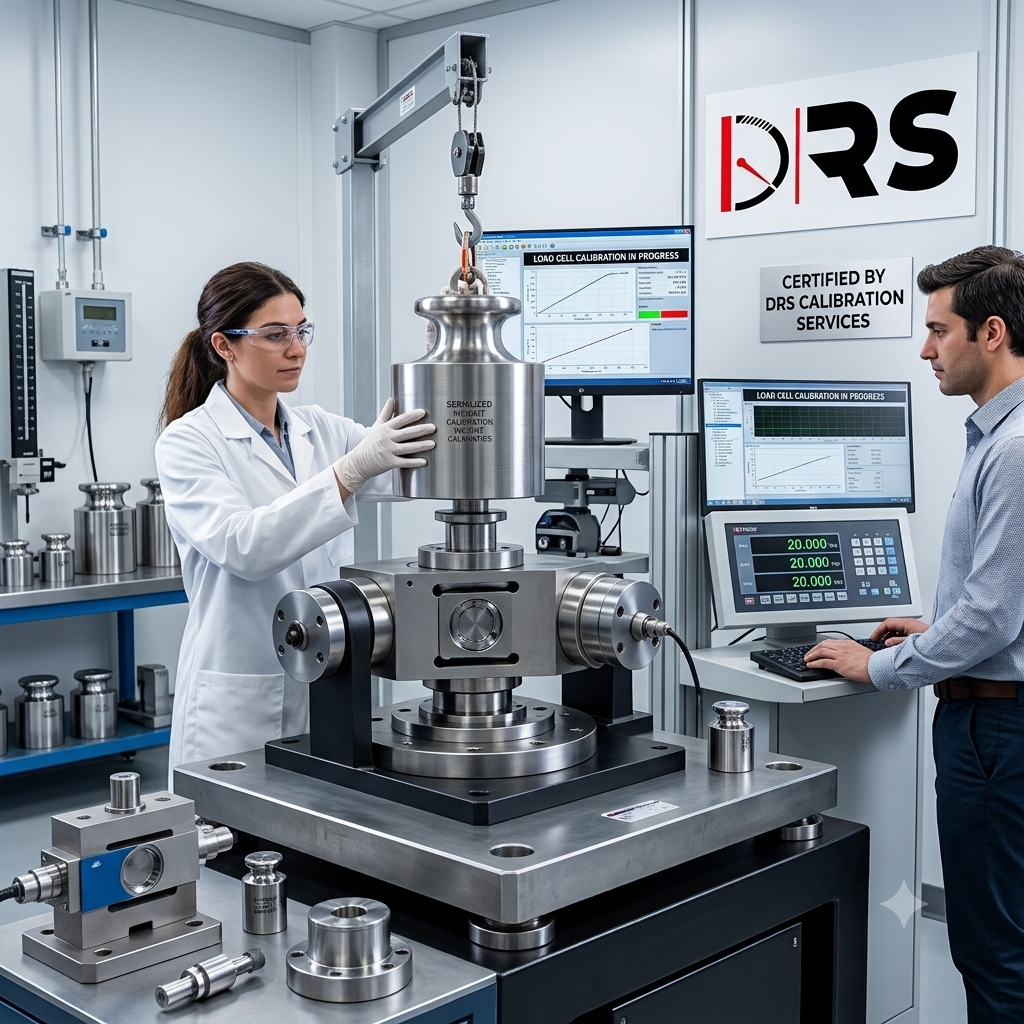
The accuracy of industrial weighing and structural testing depends entirely on the precision of the load cell. At DRS Technologies, we provide expert load cell calibration services to ensure your transducers convert mechanical force into electrical signals with absolute reliability. Our laboratory specializes in calibrating S-beam, pancake, canister, and button load cells, ensuring they perform within their specified tolerances for both tension and compression applications.
Why Precision Load Cell Calibration is Essential for Accuracy
Load cells are subject to physical fatigue, bridge imbalance, and environmental degradation. Over time, the strain gauges inside the cell can experience “creep” or zero-shift, leading to significant errors in weight measurement or force application. Regular calibration by DRS Technologies identifies these deviations and verifies the mV/V (millivolts per volt) output, ensuring your systems remain compliant with ISO 9001 and industry-specific quality requirements.
Our Technical Load Cell Calibration and Testing Process
The metrology team at DRS Technologies utilizes high-accuracy Dead Weight Tester and hydraulic force systems to perform a comprehensive audit of your sensors:
-
Mechanical and Wiring Inspection: We examine the cell for structural deformation, thread damage, and cable integrity to ensure signal stability.
-
Zero-Balance Verification: We measure the output of the load cell under no-load conditions to identify any permanent deformation or bridge offset.
-
Multi-Point Linearity Testing: Using NIST traceable force standards, we apply loads at various increments (typically 0%, 20%, 40%, 60%, 80%, and 100% of capacity) to verify the sensor’s linear response.
-
Hysteresis and Repeatability Analysis: We measure the difference in output when a load is applied versus when it is removed to ensure the sensor returns to its baseline accurately.
-
Signal Conditioning and Certification: We provide a detailed calibration certificate that includes sensitivity data (mV/V), as-found/as-left results, and documented NIST traceability.
Specialized Expertise for All Transducer Types
We provide professional calibration for a wide array of force measurement technology, including:
-
S-Beam Load Cells for tension and hanging scales.
-
Pancake and Low-Profile Cells for test stands and material testing.
-
Canister and Compression Cells for high-capacity tank and hopper weighing.
-
Miniature and Button Cells for medical and aerospace applications.
-
Digital Load Cells and Smart Transducers with integrated electronics.
Frequently Asked Questions Regarding Load Cell Calibration
What is mV/V sensitivity in load cell calibration?
The mV/V (millivolts per volt) rating is the output signal of the load cell at its full rated capacity. Calibration at DRS Technologies ensures this ratio is accurate, allowing your digital indicators or PLC systems to correctly interpret the electrical signal as a precise weight or force measurement.
How often should a load cell be calibrated?
Most industrial and laboratory standards recommend a calibration interval of twelve months. However, load cells used in high-cycle fatigue testing, heavy vibration environments, or outdoor scales exposed to extreme weather should be calibrated every six months to monitor for accelerated sensor drift.
What causes a load cell to fail its calibration?
The most common causes of calibration failure include physical overloading (which causes permanent deformation of the spring element), moisture ingress into the strain gauge area, and “side-loading” or non-axial force application that damages the internal bridge balance.