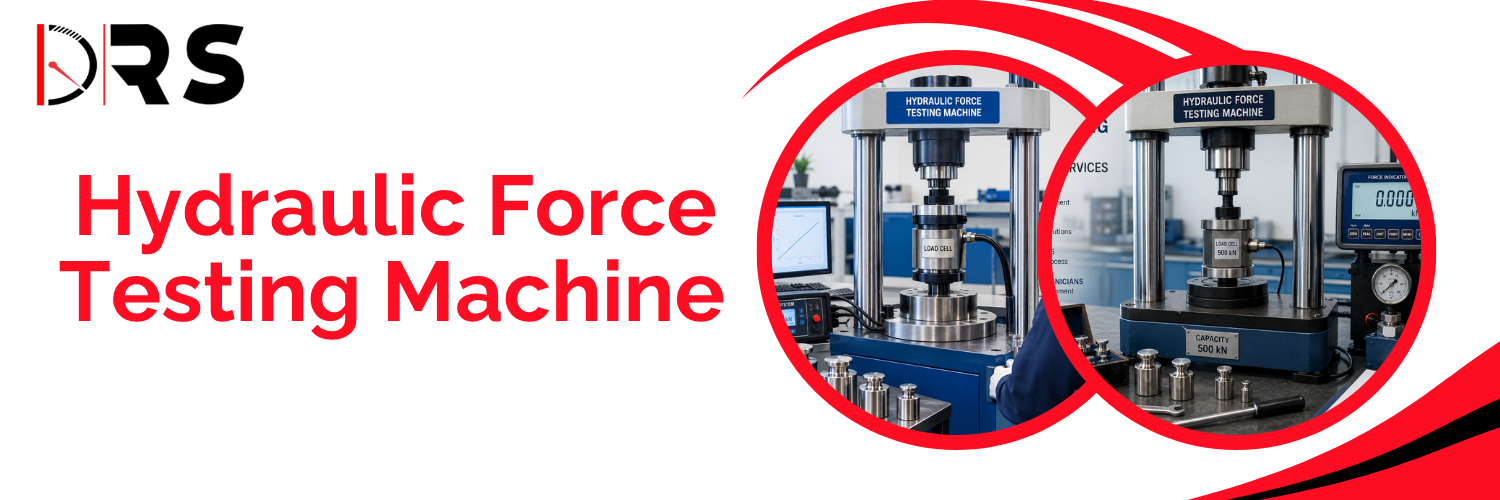
Accredited Hydraulic Force Testing Machine Calibration
The validity of your material strength data depends entirely on the accuracy of your load frame. At DRS Technologies, we provide expert on-site calibration services for hydraulic force testing machines, including Universal Testing Machines (UTMs), concrete compression testers, and industrial press frames. Our technicians verify that your equipment applies and measures force with the precision required for R&D, quality control, and structural safety certification.
Why Compliance with ASTM E4 and ISO 7500 is Mandatory
In manufacturing and civil engineering, “near enough” is not an option. Hydraulic systems are prone to pressure fluctuations, seal friction, and transducer drift that can skew force readings. Calibration by DRS Technologies ensures your machine meets the $\pm$1.0% accuracy requirement (or better) mandated by ASTM E4. This certification is essential for laboratories seeking to maintain ISO 17025 accreditation and for manufacturers who must provide legally defensible test reports.
Our Technical On-Site Calibration Process
Calibrating a hydraulic force machine requires specialized equipment and a controlled methodology. Our process includes:
-
Structural and Hydraulic Integrity Check: We inspect the crosshead, grips, and hydraulic cylinders for signs of leakage, misalignment, or excessive wear that could affect axial loading.
-
Multi-Range Force Verification: Using high-accuracy reference load cells (transfer standards), we verify the machine’s indicated force against actual applied force at a minimum of five points per range.
-
Repeatability and Resolution Audit: We perform multiple test cycles to ensure the machine returns consistent results and that the display resolution meets the requirements for the specific class of machine.
-
Strain and Displacement Calibration: (Optional) If your machine uses extensometers or LVDTs, we verify the accuracy of the displacement measurements critical for calculating Young’s Modulus and elongation.
-
Comprehensive Certification: We issue a formal Calibration Report featuring “As-Found” and “As-Left” data, measurement uncertainty, and a clear statement of compliance with ASTM E4 or ISO 7500-1.
Specialized Support for Heavy-Duty Testing Equipment
We provide professional calibration for a wide array of force-generating systems:
-
Universal Testing Machines (UTMs): Tension, compression, and bend testing systems.
-
Concrete Compression Testers: High-capacity frames for construction materials.
-
Hydraulic Press Frames: Verification of stamping and forming pressures.
-
Servo-Hydraulic Fatigue Systems: Dynamic and static force verification.
Frequently Asked Questions Regarding Machine Calibration
How often should a hydraulic testing machine be calibrated?
Standard practice and ISO/ASTM requirements dictate that force testing machines must be calibrated every 12 months. Additionally, recalibration is required if the machine is moved, undergoes major repairs, or if the load-sensing system is adjusted.
What is the difference between ASTM E4 and ISO 7500-1?
Both are international standards for the verification of static uniaxially testing machines. ASTM E4 is the primary standard used in North America, while ISO 7500-1 is more common in Europe and international markets. DRS Technologies is equipped to calibrate to either standard based on your facility’s requirements.
Can you calibrate the software and the physical load cell together?
Yes. Our calibration verifies the entire measuring chain, from the physical load cell and hydraulic pressure to the software’s final digital output. This “system” calibration ensures that the data you see on your computer screen is what is actually being applied to the specimen.