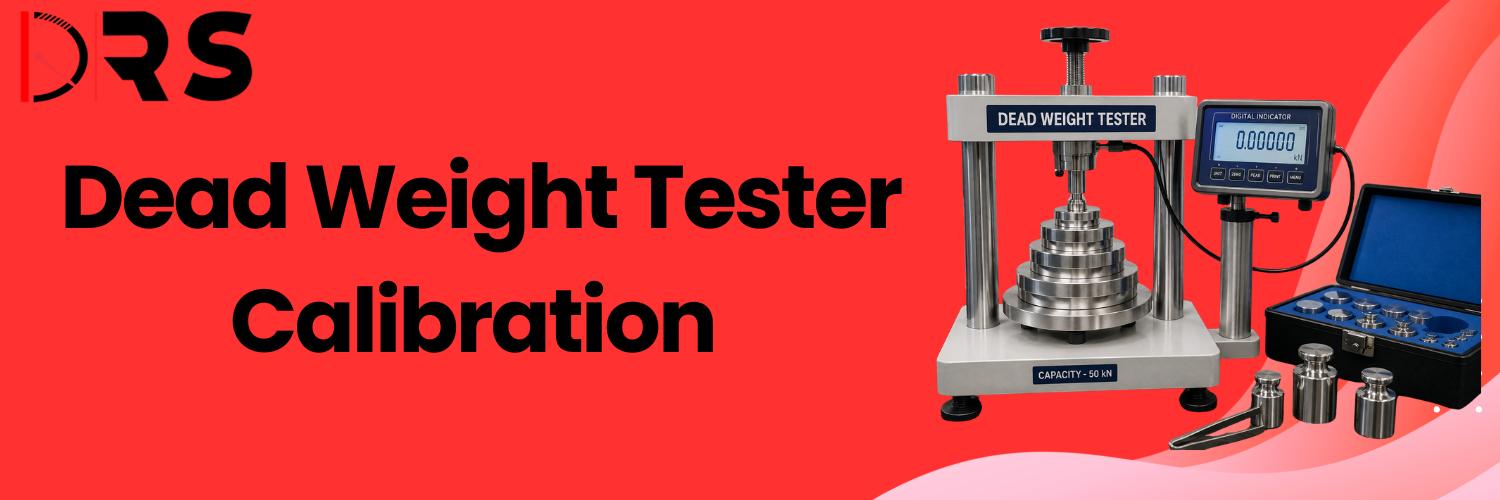
High-Precision Dead Weight Tester Calibration Services
In the world of pressure metrology, the Dead Weight Tester is the gold standard for accuracy. At DRS Technologies, we provide expert calibration services to ensure your DWT maintains its status as a primary pressure standard. Our laboratory specializes in the meticulous verification of both hydraulic and pneumatic systems, ensuring that the fundamental relationship between force and area remains precise according to international standards.
Why Primary Standard Calibration is Essential for Lab Integrity
Because a Dead Weight Tester calculates pressure ($P = F / A$), any change in the mass of the weights or the effective area of the piston-cylinder assembly results in an immediate measurement error. Over time, friction, microscopic wear, and contamination can degrade these components. Regular calibration by DRS Technologies ensures your laboratory remains compliant with ISO/IEC 17025 and that your secondary gauges are being referenced against a truly accurate source.
Our Technical DWT Calibration and Verification Process
Our metrology experts perform a comprehensive analysis that goes beyond simple pressure checks to include fundamental physical variables:
-
Piston-Cylinder Cleaning and Inspection: We perform high-level cleaning to remove microscopic debris and inspect the assembly for scoring or physical wear that could impede the “free-float” time.
-
Mass Verification and Adjustment: Each individual weight in the set is cleaned and weighed against NIST-traceable mass standards to ensure the force exerted is exactly as specified.
-
Effective Area Calculation: We verify the effective area of the piston-cylinder assembly, accounting for thermal expansion and elastic deformation under high pressure.
-
Sensitivity and Spin-Rate Testing: We measure the piston’s ability to remain in a “free-float” state and its sensitivity to small weight increments, which are critical indicators of the system’s mechanical health.
-
Gravity and Environmental Correction: Our certificates provide the necessary data for local gravity, temperature, and air buoyancy corrections, ensuring the highest level of measurement certainty.
Expertise Across All Pressure Ranges and Media
DRS Technologies supports a wide variety of dead weight testing equipment, including:
-
Pneumatic Dead Weight Testers (Gas-operated)
-
Hydraulic Dead Weight Testers (Oil or Water-operated)
-
Vacuum Dead Weight Testers
-
High-Pressure Dual-Range Systems
We service equipment from all leading manufacturers, providing the technical documentation required for your most demanding quality audits and research applications.
Frequently Asked Questions Regarding Dead Weight Tester Calibration
Why is local gravity important for dead weight tester calibration?
Since a DWT relies on the force of gravity acting on a known mass, the local acceleration of gravity ($g$) directly affects the pressure generated. DRS Technologies provides the necessary calculations so you can adjust your readings based on your specific geographic coordinates, ensuring the device remains accurate at your facility.
How often should a dead weight tester be calibrated?
As a primary standard, a DWT typically requires calibration every one to three years, depending on the stability of the environment and the frequency of use. However, the weights should be inspected annually for any signs of corrosion or wear that could alter their mass.
What is the “Free-Float” time in DWT calibration?
Free-float time is the duration the piston remains suspended and rotating without touching the cylinder walls. A decrease in float time often indicates contamination or wear. During calibration, DRS Technologies verifies this to ensure the piston-cylinder assembly is operating with minimal friction.